Follow along in this Elastic Sewing Guide to take the guesswork out of selecting the best elastic for your sewing projects.
Have you ever visited your local fabric store and perused the notions aisle and noticed ALL the different types of elastic? It can be a little confusing and overwhelming.
So, I put together this Elastic Sewing Guide to help you to not only select the best elastic for your next sewing project, but to have a better understanding of elastic for sewing in general.

Elastic Sewing Guide
The three most common types of elastic used in home sewing are braided, knit, and woven. Each type has it’s strengths, weaknesses, and purpose.
Braided Elastic
This type of elastic is most suited for use with casings. Braided elastic has distinct parallel ribs that run the entire length of the elastic.
You should know that this elastic loses its stretch and weakens when pierced by a sewing needle or pins. It also becomes narrower as it is stretched. Which is why this type of elastic is best suited for enclosing in casings, such as waistbands, sleeves, or even necklines.
- narrows when stretched
- do not sew directly on elastic
- use in casings
- for use with lightweight fabrics

What is a Casing?
In case you’re unfamiliar with the term “casing” in sewing, a casing is a folded over edge of fabric or an application (like bias tape) that is applied separately to the garment. The purpose of the casing is to enclose a drawstring tie or elastic. Casings are used at the waist, ankle or wrist when constructing clothing, or at the opening of a bag or purse.
Knit Elastic
Unlike braided elastic, knit elastic is smooth in appearance and does not get narrower as it is stretched nor does it lose its stretch when sewn. It’s perfect for use with lightweight and some medium-weight fabrics.
- does not narrow when stretched
- can sew directly on elastic or use in casing
- soft and versatile
- for use with lightweight fabrics

Woven Elastic
Woven elastic can be easily identified by its vertical and horizontal ribs. It does not lose its strength or weaken when sewn. It’s perfect for use with heavy-weight fabrics, such as what is used in outerwear. It is often referred to as “no-roll” elastic. And is great for home décor projects.
- does not narrow when stretched
- can sew directly on elastic or use in casing
- very strong
- great for medium-weight and heavy-weight fabrics
There are also some specialty elastics that are used for specific applications, such as swim, lingerie, and even fold-over elastic.

Swim Elastic
Swim elastic is a type of braided elastic that can hold up to chlorine and salt water. It is typically constructed of rubber and cotton. Just like the braided elastic, swim elastic loses its stretch and weakens when pierced by a sewing needle or pins.

Lingerie Elastic
Lingerie elastic is usually a type of knit elastic. It comes in many colors, widths, and even finishes. Some even have a soft, sort of plush, back which makes the elastic more comfortable against the skin.

Fold-Over Elastic
Fold-over elastic is a decorative elastic that can be easily identified by the small ridge that runs down the center of the elastic. This ridge is what allows the elastic to fold in half. Unlike braided elastic, it does not lose its elasticity when sewn or pinned. Thus, making it perfect for encasing raw edges. It’s often used in finishing undergarments. It can also be used to finish armholes and necklines for knit fabrics.

Elastic Thread
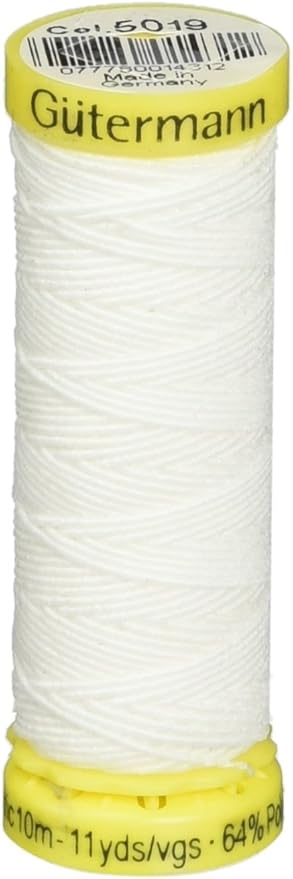
Elastic thread is a type of elastic that is used most commonly in shirring fabrics. Shirring is a type of gathering.
- great for shirring or gathering fabric

Clear Elastic
Clear elastic is neither knit nor woven. If you sew on clear elastic, it will actually puncture the elastic. It is great for use to stabilize seams that may receive stretch. It can be finicky to work with and using a Teflon presser foot will help a lot!
- thin, durable, and stretches up to 4 times its size
- adds stability and elasticity to seams
Download the Elastic Sewing Guide
If you’d like to have a printed version of this Elastic Sewing Guide (without the ads) just sign up below:
Once you sign up, the guide will be delivered to your email inbox. You’ll also be subscribed to receive the Hooked on Sewing newsletter. Feel free to unsubscribe at any time (but I hope you don’t).

Summary
There is so much more we could talk about on the subject of sewing with elastic. But, I think this is enough for now. I really wanted to familiarize you with the different types of elastic.
At least now you’ll have a better understanding of why a particular pattern may call for a specific type of elastic. Or be able to determine for yourself just which type will work best for your sewing project.
Questions?
If you have questions about sewing with elastic, feel free to leave them in the Comments below.
More Sewing Tutorials
If you enjoyed learning about sewing with elastic or maybe you’re new to sewing, you’ll find plenty of sewing tutorials and patterns right here on Hooked on Sewing.
And be sure to check out the entire Learn to Sew series. You can follow along with these sequential sewing lessons or pick and choose which sewing lesson you want to learn.



Hi please can you advise me , I am sewing box cushion covers with canvas/pvc backed fabric … I would like to use elastic in the corners (like a fitted sheet) ie to stretch over current cushions … the fabric is thick … I need advise on what elastic to use and wether this will be possible .. I Have already had a practice run and elastic i am using is 2cm thick and it did not gather fabric tight enough , Help please 🙂
Hi, Ruby. I would definitely use a woven elastic. Woven elastic is specifically designed for heavy-duty applications and will hold up well to the weight and coarse texture of canvas fabric. I think you’ll probably want to use elastic that is at least 1″ (or approximately 2.54cm) wide.
Please let me know what you use and how your project turned out!
Pam Baker
Hooked on Sewing